Photo credit unknown
I have begun my seven-week training on Fundamentals of Bringing Yoga and Meditation into Military Communities.
From my experience sharing Yoga with the young combat veteran and from his recent lashing out and defiant withdrawal from me as coping mechanism, I am even more grateful for the scholarship that I was awarded to attend this training. It is part one of three offered for certification through Warriors At Ease. They have guided me through my work with this troubled and promising young man. Help is needed, Rush Order.
I hope that this program offers me more knowledge and wisdom so that I might become even more successful merging Yoga with trauma recovery and working with vulnerable populations. I know that I did good work with him, with integrity and honesty, yet, naturally, l feel a lack of closure. He up and disappeared! I believe that I exposed his vulnerabilities to him in a way that he wasn’t prepared to integrate, in a moment of insensitivity to his mood, via text. I do not take responsibility for his isolating behavior, however. I am moved by his pain. He has been a phenomenal, inspiring teacher to me. I need to learn more.
I miss working with him. Maybe he’ll come around.
My experience establishing a research program and teaching trauma-informed Yoga for San Luis Obispo County Drug and Alcohol Services through the Adult Treatment Court Collaborative to parolees with dual diagnosis (mental health and substance abuse disorders), a thirteen-week pilot program which ended December 22, 2014, was traumatizing to me.
The program showed, through self-reported questionnaires, improved mental health, mindfulness, breath awareness, quality of life, symptoms and medication compliance and adherence – in other words, we met our therapeutic objectives. I am ever-grateful for the experience, though I find that I am still integrating to the point of quiet introspection. From sex-offenders and threatening gang members to a chaotically disintegrating program and bureaucracy that is resistant and dysfunctional… it was an eye-opening and exhausting experience.
Despite the successful outcome, and though I procured all materials through donations (mats, blankets, a stereo, thirty-six eye bags used as weights hand-sewn by another Yoga student), the County has chosen not to resume offering Yoga to it’s clients due to lack of funding.
The financial glitch is in paying the Yoga teacher, apparently.
No real need to express my disillusionment and disappointment… and I have been galvanized once again to continue forging Yoga programs in agencies and organizations, privately and in groups, for mental health, seemingly against all odds. I remain hopeful, because Yoga works, though I am feeling financially strapped for the time being.
As I recover from these two intense experiences – my sense of dismissal by the veteran and the County – I honor the secondary trauma that I incurred in these contexts by spending time with the traumatized, as well as by my primary trauma – my own responses to personal triggers. I have succumbed to this national flu epidemic and have been spending much time in seclusion. It has been a great retreat, despite the illness.
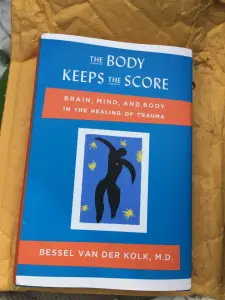
My new copy of The Body Keeps the Score: Brain, Mind and Body In The Healing of Trauma by Bessel Van der Kolk, MD came in the mail this week. There are numerous passages that I underlined, navigating not by page but by bibliomancy. I will quote some of the mind-bending concepts below.

From The Body Keeps the Score: Brain, Mind and Body In The Healing of Trauma by the good Doctor Bessel Van der Kolk:
…Emotional intelligence starts with labeling your own feelings and attuning to the emotions of people around you… p 354
…Resilience is the product of agency: knowing that what you do can make a difference… p 355
…Disturbing behaviors started out as frustrated attempts to communicate distress and as misguided attempts to survive… p 352
… Identifying the truth of an experience is essential to healing from trauma… Predictability and clarity of expectations are critical; consistency is essential… p 353
…If you are not aware of your body’s needs, you can’t take care of it. If you don’t feel hunger, you can’t nourish yourself. If you mistake anxiety for hunger, you may eat too much. And if you can’t feel when you’re satiated, you’ll keep eating. This is why cultivating sensory awareness is such a critical aspect of trauma recovery. Most traditional therapies downplay or ignore the moment-to-moment shifts in our inner sensory world. These shifts carry the essence of the organism’s responses: the emotional states that are imprinted in the body’s chemical profile, in the viscera, in the contraction of the striated muscles of the face, throat, trunk and limbs. Traumatized people need to learn that they can tolerate their sensations, befriend their inner experiences, and cultivate new action patterns… p 273
…Safe areas can help [traumatized] kids calm down by providing stimulating sensory awareness: the texture of burlap or velvet; shoe boxes filled with soft brushes and flexible toys. When the child is ready to talk again, he is encouraged to tell someone what is going on before he rejoins the group… p 353
On confidence:
…As long as we feel safely held in the hearts and minds of the people who love us, we will climb mountains and cross deserts and stay up all night to finish projects. Children and adults will do anything for people they trust and whose opinion they value… p 350
Most fascinating to me, on the history of trauma recovery and combat veterans:
…Greek drama may have served as a ritual reintegration for combat veterans.At the time Aeschylus wrote the Oresteia trilogy, Athens was at war on six fronts; the cycle of tragedy is set in motion when the returning warrior king Agamemnon is murdered by his wife, Clytemnestra, for having sacrificed their daughter before sailing to the Trojan War. Military service was required of every adult citizen of Athens, so audiences were undoubtedly composed of combat veterans and active-duty soldiers on leave. The performers themselves must have been citizen-soldiers…
…Sophocles was a general officer in Athens’s war against the Persians… his play, Ajax, reads like a description of traumatic stress… p 332
On rhythmic rituals instilling hope and courage:
… Roman general Lycurgus had introduced marching in step to the Roman legions and the historian Plutarch had attributed their invincibility to this practice… This collective ritual not only provided his men with a sense of purpose and solidarity; but also made it possible for them to execute complicated maneuvers…to this day the major services of the U.S. military spend liberally on their marching bands, even though fifes and drums no longer accompany troops into battle… p 334
…Traumatized people are afraid of conflict… p 335
…If you want to give them a sense of control, you have to give them power over their destiny rather than intervene on their behalf… You cannot help, fix, or save the young people you are working with. What you can do is work side by side with them, help them to understand their vision, and realize it with them. By doing that you give them back control… p 342
…Learning to experience and tolerate deep emotions is essential for recovery for trauma. p 344
…Because [Shakespeare in the Courts] is committed to not throwing kids out as much as possible… p 344
…People can learn to control and change their behavior, but only if they feel safe enough to experiment with new solutions. p 349
…Attempts to cope with emotions become unbearable because of lack of adequate contact and support… p 349
…Trauma remains a much larger public health issue, arguably the greatest threat to our national well-being… p 348
…Psychiatry’s obtuse refusal to make connection between psychic suffering and social conditions… p 348
…Rampant prescription of painkillers, which now kill more people each year in the United States than guns or car accidents. p 349
…Trauma devastates the social-engagement system and interferes with cooperation, nurturing, and the ability to function as a productive member of the clan… ‘My humanity is inextricably bound up with yours’… [translation of the Xhosa word and principle of ubuntu]… p 349
On healing, breathing and the importance of heart rate variability:
…To promote reciprocity, we use mirroring exercises, which are the foundation of safe interpersonal communication… imitating facial gestures and sounds and then get up and move in sync. To play well, they have to pay attention to really seeing and hearing one another… trying to keep a beach ball in the air… computer games to help them to focus and improve their heart rate variability … p 354-355
… Heart rate variability measures the relative balance between the sympathetic and the parasympathetic systems. When we inhale, we stimulate the SNS, which results in an increase in heart beats. Exhalations stimulate the PNS, which decreases how fast the heart beats. In health individuals inhalations and exhalations produce steady, rhythmical fluctuations in heart rate: Good heart rate variability is a measure of basic well-being…. p 267
A good yoga teacher will encourage you to just notice any tension while timing what you feel with the flow of your breath: ‘We’ll be holding this position for ten breaths.’ … Awareness that all experience is transitory changes your perspective on yourself… Intense physical sensations unleashed the demons that had been so carefully kept in check by numbing and inattention. This taught us to go slow, often at a snail’s pace. That approach paid off… p 274
On shock:
…People who are… scared can’t think straight, and any demand to perform will only make them shut down further. If you insist, they’ll run away and you’ll never see them again… p 263
…[The] amygdala… had been rewired to interpret certain situations as harbingers of life-threatening danger and it [sends] urgent signals to [the] survival brain to fight, freeze, or flee… p 265
On cultivating interoception:
…In yoga you focus your attention on your breathing and your sensations moment to moment. You begin to notice the connection between your emotions and your body-perhaps how anxiety about doing a pose actually throws you off balance. You begin to experiment with changing the way you feel. Will taking a deep breath relieve that tension in your shoulder? Will focusing on your exhalations produce a sense of calm?… Simply noticing what you feel fosters emotional regulation… Once you start approaching your body with curiosity rather than fear, everything shifts… Trauma makes you feel as if you are stuck forever in a helpless state of horror. In yoga you learn that sensations rise to a peak and then fall… Yoga turn[s] out to be a terrific way to (re)gain a relationship with the interior world and with it a caring, loving, sensual relationship to the self… p 273